Showing posts with label Books. Show all posts

Friday, April 30, 2010

Book Review: The Reason for God by Tim Keller

In The Reason for God: Belief in Age of Skepticism, Tim Keller addresses the most common questions and doubts of skeptics that he has encountered, and offers a number of reasons to believe the truth of the Gospel. As the founding pastor of Redeemer Presbyterian Church in Manhattan, Keller is no stranger to the urban, post-modern, intellectual skeptic. It is clearly this sort of person Keller has in mind as he provides gracious answers to pressing doubts.

Before addressing these doubts, Keller presents a most interesting introduction in which he introduces his working premise: that every doubt is based on a set of alternate beliefs. He uses the example of someone who opposes Christianity because it seems exclusionary. This person argues that there can’t
be just one true religion, all the while never realizing that their statement is really an alternate belief that requires faith. It can’t be proven empirically. It is not universally accepted. This “reasoning” is just as much a position based on faith as the Christian’s is, if not more so. These sorts of embedded leaps of faith reappear throughout.

After the introduction, the rest of the book’s first half is devoted to addressing the questions and doubts of skeptics. Here, Keller is at his best. It is easy to imagine him deftly answering challenges at one of his post-sermon Q&A sessions at Redeemer. I especially appreciated his analogies, many of which I will hold onto and use in my own ministry for years to come. For instance, in his chapter entitled, “Christianity is a Straitjacket,” Keller addresses the widely-held fallacy that real human freedom is a maximal lack of constraint, that the truly free person is the one who decides for herself what is right and what is wrong without having morality imposed upon her by another. Keller uses two analogies that are simple, yet brilliant, to prove that freedom is not simply a lack of constraint. First, he presents a musician who has given up hours upon hours in order to practice and perfect his craft. He was most certainly constrained by such diligence, but because of it, he is now free to express himself musically in ways he would never have been able to had he been “free” from constraint. Then, Keller turns his attention to an even more universal analogy, that of love. He writes: “If you want the ‘freedom’ of love – the fulfillment, security, sense of worth that it brings – you must limit your freedom in many ways…To experience the joy and freedom of love, you must give up your personal autonomy.” Anyone who has experienced a love relationship will be able to relate to this “trade” of personal freedom for intimacy, and will likely agree that it is worth the constraint.


The second half of the book changes focus, from answering doubts to presenting “sufficient reasons for
believing.” Keller asks his reader to “put on Christianity like a pair of spectacles and look at the world with it. See what power it has to explain what we know and see.” This tour of the Christian worldview includes a review of various evidences that point to the existence of God, a discussion of moral obligation as a divine fingerprint, an explanation of the fallen world we see around as through the lens of sin, and a presentation of the Gospel.

This section did not seem as strong to me as the book’s first half did. Nevertheless, I thought the chapter delineating between religion and the Gospel was very well done. Keller writes: “The primary difference is that of motivation. In religion, we try to obey the divine standards out of fear… In the gospel, the motivation is one of gratitude for the blessing we have already received because of Christ.” Here, we hear an echo of an earlier chapter, denouncing fanaticism as modern-day Pharisaism. Moralist religion is not the Gospel of Jesus Christ. By making this distinction, Keller gives himself ground to criticize the abuses of Christian “religion” in the world even as he advocates forcefully for the Gospel.


On the whole, I was very impressed with Keller’s book. He speaks powerfully, yet gently, and he addresses questions that people are actually asking. The first half seems to me especially powerful for equipping believers to address these questions as well. I would be interested to hear the perspective of a seeker or skeptic who has read the book, but it seems to me the arguments would resonate. Based on clarity, utility, and provocation of thought, this is the best book I have read in any of my classes this semester.

Friday, April 17, 2009

A Living Eucharist

In Chapter Six of JWTSC (see immediately previous post), Rob Bell and Don Golden talk about the concept of Eucharist.

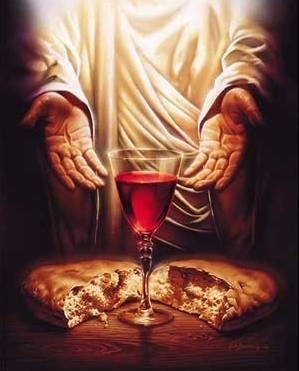
The word itself comes from the Greek word eucharizomai, meaning thankful or thanksgiving. Literally the word means “to give what is good.” Thus, we can say that what we celebrate in the Eucharist (or the Lord’s Supper, or Communion, or whatever your tradition calls it) is God’s “good gift” to mankind, the gift of Jesus Christ. Through His sacrifice on the cross, God reconciles all of creation to Himself. Jesus’ body was broken and His blood was poured that you and I might reap the benefits of forgiveness and eternal life.

And this is the authors’ intent in talking about Eucharist. As they put it, “For someone to receive, someone has to give...If someone somewhere benefits, then someone somewhere has paid something.” (pg. 149)

Eucharist is about sacrifice. About a good gift that is given, but not without a price.

The Eucharist we celebrate is all about the body of Christ being broken, and the blood of Christ being poured out, for the sake of others. Thus, if we who would call ourselves Christians are truly the body of Christ, then a Christian ought to be “a living Eucharist, allowing her body to be broken and her blood poured out for the healing of the world.” (pg. 150)

That is our calling. That is life in the way of Jesus. Seeking to be broken and poured out for the sake of others. It’s why we still marvel at the lives of Mother Teresa, and Hudson Taylor, and Jim Elliot, and Brother Andrew. They were broken and poured out for God’s glory, and it cost them something. We marvel at these lives because there’s something in us that knows they are what life in Christ is supposed to be.

The problem is, we look at these heroes of the faith and subconsciously we say, “I’m no Mother Teresa. I'm glad she did what she did, but I could never do that, so I’m going to abandon this brokenness thing altogether.”

And that is where we miss the mark. The way of brokenness, the path of descent, is a journey. It is a counter-cultural lifestyle that must be learned and nurtured and mastered over time. It is a day-by-day yielding to the Holy Spirit by which we surrender more and more control over our lives to God, until we have eventually given Him everything. It is then that we will be living the Christian life as it was meant to be lived.

So where to begin this journey of brokenness? The authors raise a couple of questions that are of help here:
The Eucharist is what happens when the question is asked, What does it look like for us to be a Eucharist for these people, here and now?

What does it look like for us to break ourselves open and pour ourselves out for the healing of these people in this time in this place? (pg. 158)
Think about your neighborhood. Your city. Your workplace. Your family. What would it look like to break yourself open and pour yourself out for the healing of others in these places?

Maybe it’s buying some groceries for a neighbor who’s unemployed. Maybe it’s buying those groceries every week until he gets a job.

Maybe it’s having lunch with a coworker you never talk to. Maybe it’s having lunch with them every week until you can call yourself friends.

Maybe it’s giving away everything in your house that you don’t need. Which is probably most everything you own.

Maybe it’s donating your best clothes to Goodwill, instead of giving them your worn out and ill-fitting clothes like we usually do.

Maybe it’s realizing that you have an extra bedroom and offering it to someone who is struggling financially, or maybe just to someone you want to share life with.

Whatever it is, whatever you do, it should cost you something and benefit someone else. If you can do it and not feel the sacrifice of it, it’s not Eucharist. At least, not Eucharist in the way of Christ.

Believe me, living as a Eucharist is as big a challenge to me as it is to anybody. But isn’t it a challenge worth taking? These ideas inspire me, and spur me on to want deeper sacrifices and more selflessness in my own life. Surely, living broken and poured out for the sake of others is not an easy way to live. But it is surely the best way.

Lord Jesus, grant me the strength today to break myself open and pour myself out for someone else. Take my selfishness from me and give me the courage to lay down my life, that others might be healed. I desire to be a Eucharist, just as You are a Eucharist. In Your Name, and for the sake of Your Glory, I pray. Amen.

Tuesday, April 14, 2009

Jesus Wants to Save Christians


I recently finished reading Rob Bell’s latest book, the provocatively titled, Jesus Wants to Save Christians: A Manifesto for the Church in Exile. Co-authored with Don Golden of World Relief, the book traces the history of the nation Israel through four time periods that correspond to the places where they occurred.

Egypt: The place of crying out to God, and experiencing God’s response to that cry, which is salvation.

Sinai: The place of covenant between the nation and God, of new identity and a new way of living.

Jerusalem: The place of distraction, where power corrupts the original vision of what the nation was meant to be, where they lose the thread of their own story.

Babylon: The place of exile, where the nation once again cries out to God and contemplates what comes next.

The authors use this pattern as a launching pad to talk about “the church in exile,” suggesting that we as Jesus followers have lost our own story, that we need to cry out to God for His restoration, and that we are faced with a great opportunity to re-imagine the church, to re-imagine ourselves as the people of God.

In all honesty, I found most of the book to be a bit of a slog. Not that it wasn’t engaging, but more that it seemed not to be going anywhere. But the last chapter and the epilogue blew me away. The rest of the book was simply setting the table for the feast of truthy goodness that was to come.

So I have decided to explore some of the ideas and themes put forth in the final chapter and epilogue, bit by bit, day by day, here on the blog. I do this in part to help solidify my own thinking and response, and in part to put forth these ideas in the hope that they will resonate with others as deeply as they have resonated with me.

The themes are deep and rich: being a living Eucharist to the people around us, seeking to live broken and poured out for the sake of others, discovering a new humanity in our church community, avoiding the dangerous seduction of demographics and marketing, embracing the path of descent as Jesus did, to name a few.

I can’t say how long this examination will last, or that there will be significant insight gained from the experience. None the less, I’m excited for the endeavor.

Friday, February 20, 2009

Free Books!


Like to read? Books are good, free books are better!

Some friends of ours have started up a new blog called "Bookaway", designed to be an online book exchange of sorts.

If you'd like a free book, or if you have books to give away, visit this site to check it out.

Bookaway!

Thursday, October 16, 2008

Our New Small Group

This past Monday, we wrapped up two weeks worth of traveling just in time for the kickoff of one of our church's brand new small groups.

I love the concept of small group - it provides a context for relationships and discipling not possible in 'big church'. Through the first adult small group that Gary and I ever participated in came our calling to youth ministry (a story I really need to blog on someday!). Unfortunately, due to scheduling issues we've had trouble getting plugged into one at Fair Oaks up to this point.


So, we were pretty stoked to get together Monday along with four other (OUR AGE!!!!!) couples. All groups will be kicking off this fall by going through Peter Scazzero's Emotionally Healthy Church Workbook.

The workbook is based on the book by the same name, which Gary and I read one year ago as part of the Retool Kit process. It proposes that emotional and spiritual maturity are linked, and that by evaluating and growing in our emotional maturity we will be able to overcome roadblocks to growing spiritually.

What struck me about our meeting this past Monday was an unusually high level of openness and authenticity, especially for a first meeting. (It helps that certain couples are friends with other couples in the group, but this is the first time we've all hung out together) This is a group of people who want to build good relationships and true community. I'm really excited for the potential of this group and to see where God leads us throughout the coming year.

Are you in a small group at your church? Why / why not? I invite you to leave a comment and share what factors have helped to build community within your group.

Thursday, September 18, 2008

Book Review: a Generous Orthodoxy


So, I've been curious to read this book since it came out four years ago. In various reviews, I've read a lot of backlash, and had mentally placed this book in the 'books I SHOULD read but am putting off until I've read everything else on my bookshelf first' category.

Well, I finally got around to reading the book and was amazed at how much I enjoyed it! I just couldn't put it down. For a girl from a mostly non-denominational Christian background, I found McLaren's descriptions of various streams of faith to be fascinating.

Critics accuse him of attempting to piece-meal a post-modern version of Christianity "with an eccentric mix of theological elements pieced together from main denominations and even many different religions", or that "he embraces relativism at the cost of clarity in matters of truth and intends to redefine Christianity for this new age, largely in terms of an eccentric mixture of elements he would take from virtually every theological position and variant."

Yet, I didn't come away feeling that McLaren was trying to impose a new, mish-mashed form of Christianity upon the rest of us. Rather, he holds to light the pearls of truth that were the impetus for each of many different Christian traditions (even while acknowledging how many have since lost sight of their honorable beginnings).

To better understand how other traditions are attempting to sincerely live out their faith, and to learn and draw from other's strengths can only help us be more loving and unified as the worldwide body of Christ, regardless of denomination. McLaren addresses the unity of the church this way, in my favorite passage of the book:

"We believe in one... church," the [Nicene] creed says, and that's no easy to swallow statement because we're surrounded by denominations, divisions, arguments, grand polemics, and petty squabbles. That's where the "we believe" part comes in: you can only know the unity of the church by believing it, not by seeing it. When you believe it, you can see through the surface dirt and cracks to the beauty and unity shining beneath. Generous orthodoxy presumes that the divisions, though tragic, are superficial compared to Christianity's deep, though often unappreciated, unity. Perhaps the more we believe in and perceive that unity, the easier it will be to grow beyond the disunity." p. 250


The church, not the building, but the family of God's adopted children, should indeed be radiantly beautiful. Let's spend a little less time taking sides and articulating our differences, and focus more on how amazing and merciful our loving God is to each of us. Sounds pretty generous to me.

Friday, August 22, 2008

On My Mind

So, this has turned out to be a month of not much blogging. There's been so much going on it's kind of taken back seat for a while. But not to fear, I haven't given up completely. Just to keep you in the loop, here's just a smidgen of what's been rolling around my mind:

- Hospitals and Doctors: Up until the past couple of months, I haven't spent too much time around them. Now that I am, as an advocate, I've been surprised and disappointed with my experiences. Care providers are happy to help with a symptom, but forget it if you want to discover and treat the cause. I believe I have some squeaky-wheeling in my future. Grr.


- The Shack: A work of fiction that has created such a buzz that I've tried to avoid it. Well, I wasn't able to, and now I am so glad that I finally gave in and read the thing. Once I started, I couldn't stop, and devoured the book in two days. The author creates such a fantastic word picture of a living, breathing relationship with God. I was amazed at what an encouragement I found this book to be. I'd definitely recommend it to anybody, Christian or not, especially those struggling to reconcile God's goodness with the problems and evil in the world. Excellent!


- New neighbors: Eric, the new worship leader at our church, and his wife Yvette, finally found a place of their own here in Concord. For the past six weeks, they've been living out of boxes and dealing with a lengthy commute while looking for the right place. Well, God has provided - they're moving into a house one street down from ours! It's literally a five minute walk from our front door. We are so excited to get to know one another better - what a blessing!

- Billy: I took my little doggy to the vet today for a routine vaccination and when I reviewed his records, realized that he is NINE years old! That came as a little bit of a shock to me, as we've really only spent three years with him. He wasn't a puppy when we adopted him, and we left him with my parents for a year when we went on the world race mission trip. But now, his right eye is getting cloudy, and the vet told me it's a sign of aging. What! Billy can't be getting old. No, no, no.

- The new school year: Yes, I'm excited. Nothing fires me up more than the possibilities in a new beginning. Yet, I sense that my role in youth ministry is going to have to be more defined and less all-encompassing than it has been in the past. I dread the moments when I am going to have to, at some point, say NO to myself, my students, and worst of all, to my husband. But I don't see a way around that if I'm going to keep myself and my marriage healthy for the long term.

I guess it's kind of like planting a garden - you're supposed to plant all the seeds, then uproot all but the strongest so they have room to grow. I'm gonna have to uproot some flowers in my life, and I don't like it. Nope, not one bit. I imagine you can expect many posts along this line as I try and sort things out. Along with related topics such as identity, purpose, calling, faithfulness, discernment, and the meaning of life. Argh. I suppose I thought these things would fall into place as I got older, but the more time goes by, the more complicated it seems.

Monday, April 21, 2008

There's a Sheep in my Bathtub!


My latest read was a missionary biography called There's a Sheep in my Bathtub: Birth of a Mongolian Church Planting Movement, by Brian Hogan. Once I picked it up, I read this one so fast it didn't even make my 'currently reading' list before I was already done!

"What happens when you drop an American family with three small children into the remote post-Communist chaos of Outer Mongolia?

There's a Sheep in my Bathtub chronicles the adventures of the American Family Hogan as they try to follow God's leading into one of the world's most remote and mysterious enclaves. Disarmingly honest and laugh-out-loud funny, their tale will thrill you and bring tears to your eyes. An intensely personal memoir, this book still manages to pack a powerful dose of missionary insights and Biblical principles for seeing the Church explode into life among people that have never even heard of Jesus. Get comfortable. You will not be able to put it down."


One of my favorite parts of this book was the description of the tension the church-planters experienced when trying to balance weekly in-home small groups with larger Sunday celebration gatherings. When the ministry focus was on the small groups, the Christians grew deeper in their faith and the small groups grew and multiplied rapidly.

When they increased the frequency of Sunday worship services from monthly to weekly, everyone had a great time, many people attended, but participation in the small groups dropped off, meaning discipleship and accountability were compromised. I am very curious if churches in the United States, which focus their energies on one Sunday gathering, have had similar experiences when transitioning to a small group based ministry.

I definitely recommend this book to anyone interested in missions, church-planting, or experiencing life in a very different culture.

For those of you are interested in the story, but have shorter attention spans, you can skim a two page summary of Brian Hogan's fascinating ministry in Mongolia by clicking here.

Thursday, April 17, 2008

Amazing Grace


As "Amazing Grace" is easily my favorite hymn, and probably my favorite song of all time as well, I was very interested when this movie came out last year. Despite my excitement, I never got around to seeing the movie in the theatre, and I ended up just waiting for it to come around on our Netflix queue.

Well, the movie eventually showed up in our mailbox, so I've finally gotten to watch it for myself. It's rare that a movie surpasses my expectations, but this one did so easily. I found it beautiful, powerful, and enthralling, and I'm so glad I didn't let it slip by! The story of William Wilberforce's haunted obsession to end the slave trade would be compelling even if it weren't true; the fact that it's based on real events only adds to the sense of inspiration.

I love that this film reminds us that what one chooses to devote themselves to in life truly matters. That young people truly can change the world (Wilberforce was only 21 when he was first elected). That despite years of opposition, once can eventually overcome and find success. And most especially, that with enough blood, sweat, tears, and prayer, good can and will overcome evil.

Though there are more people in slavery today than during Wilberforce's time, much good has already come out of the release of this movie. If you're interested, check out the "The Amazing Change" campaign and this book by modern-day abolitionist Zach Hunter, encouraging people everywhere to 'be the change they want to see in this world'.

All in all, I found this movie to be cinematically worthy and personally inspiring. I've got two thumbs, and they're both up.

Wednesday, April 2, 2008

The Irresistible Revolution

A few months back, I bought a book by a guy called Shane Claiborne. As his quotes and ideas kept popping up among fellow youth pastor and missionary friends, I figured, I'd like to see what else he has to say.

(Shane also happens to be the young man who, as a speaker at the National Youth Workers Convention in Atlanta last fall, controversially devoted all of his speaking time to reading the Sermon on the Mount.)

Well, after letting the book sit on my shelf long enough, I've finally dusted it off and dug in. And, let me say, wow. Just, wow! This is a guy who yearns to live and love like Jesus did. And not in the 'feel spiritual in your Sunday clothes' kind of way, but the 'get down with the poor get your hands dirty' kind of way.

He has a lot to say about poverty, simplicity, and community; the fellowship of interdependence, the suburban isolation of the rich. It's challenging, for sure. But attractive in the sense that he appears to have found something I'm looking for.

I haven't even finished the book yet, but I'm already looking forward to re-reading it. Anybody out there wanna start a book club and discuss it with me?

The Irresistible Revolution: Living as an Ordinary Radical, by Shane Claiborne.